Weathering Change Webinar: Incorporating Climate Solutions into Day to Day Adaptation

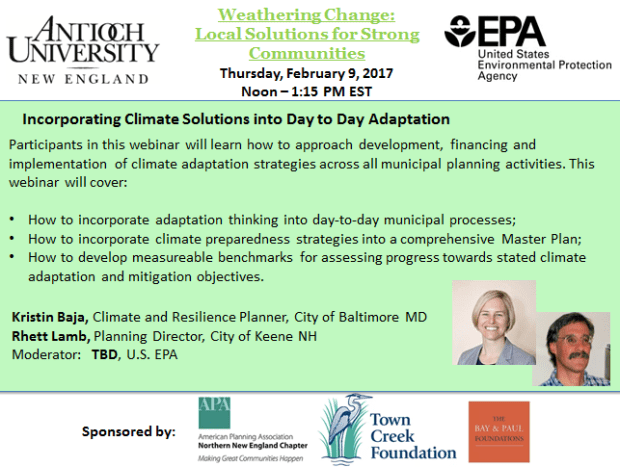
Upcoming Webinar – Thursday, February 9, 2017 – 12:00 PM – 1:15 PM EST
Incorporating Climate Solutions into Day to Day Adaptation

Participants in this webinar will learn how to approach development, financing and implementation of climate adaptation strategies across all municipal planning activities.

This webinar will cover:

  • How to incorporate adaptation thinking into day-to-day municipal processes
  • How to incorporate climate preparedness strategies into a comprehensive Master Plan
  • How to develop measurable benchmarks for assessing progress towards stated climate adaptation and mitigation objectives

fec476d1-0cfd-4ab3-9ecc-435f4d5caaa9

Save

Future of Farming in a Changing World Conference

Jen Risley's avatarYarden of Eatin'

Save the Date:
March 25, 2017 at the Monadnock Center for History and Culture in Peterborough

The Cornucopia Project will host the Future of Farming in a Changing World Conference to discuss how to build a sustainable and community-based food system, look at land availability, and how climate change will impact farming practices, with a focus on young farmers.

The keynote speaker is Philip Ackerman-Leist, professor, farmer and author of Rebuilding the Foodshed: How to Create Local, Sustainable, and Secure Food Systems.  For more information, contact Joyce at admin@cornucopiaproject.org.

cornucopiaprojectlogo_4c_new

View original post

Local Sustainable Economies Conference

lsec-logo_-300x288The Sustainable Business Network of Massachusetts is excited to present the Local Sustainable Economies Conference at Northeastern University in Boston, MA from June 7 until June 9, 2017.

The conference is intended for small and local business leaders as well as advocates who are committed to building a local, green and fair economy. The conference will focus on action as it guides participants through engaging material that results in real, attainable ideas and solutions to issues facing our environment and our local economy.

Through networking, participants will build strong connections with other leaders who are as committed as they are to building sustainable businesses and organizations that ensure the long term success of both small business and our planet. Together we can amplify our impacts in building a vibrant local economy.

The conference will examine the seven pillars of a sustainable economy:

  • Local – Catalyze the Local First movement
  • Green – Discover & deliver solutions that stop climate change
  • Fair – Create an equitable economic system that benefits all communities
  • Food – Transform our local food systems
  • Community Capital – Move capital to local entrepreneurs & unleash the power of small & mid-size business
  • Entrepreneurship – Ignite your ‘entrepreneurial spirit’ & invigorate the new economy
  • Public Policy – Organize business & community leaders to strengthen our democracy & advocate for positive local & sustainable policies

Learn more

From Hurricane to Climate Change

“According to environmentalist and author Bill McKibben, ‘Climate change is actually the biggest thing that’s going on every single day.’ In response, the Monadnock Institute of Nature, Place and Culture at Franklin Pierce University, with support from New Hampshire Humanities, has produced a documentary film focused on climate change adaptation and resiliency in New Hampshire’s Monadnock region.” – New Hampshire Humanities

https://vimeo.com/channels/1062161/175210055

Transportation Coalition Seeks Volunteers and Partners

13096267_977788955609456_919586139168187820_nThe Monadnock Alliance for Sustainable Transportation (MAST) seeks interested individuals and organizations from around the region to join the coalition in promoting transportation solutions that enhance the environmental, economic and physical health and well-being of citizens in the Monadnock Region.

MAST is a diverse coalition of public and private sector stakeholders interested in a better transportation future for the region. The group recognizes the broad impacts that our transportation system has on us as individuals and as communities – everything from employment to our cost of living to our health. For many households, a lack of affordable transportation options can present a major barrier to accessing jobs and services. In fact, transportation is the second largest expense for most households in United States after housing. According to the Bureau of Labor Statistics, the average American household spent $9,503 on transportation costs in 2015, not including gasoline/motor oil and new car purchases.

In order to address these challenges, MAST has emerged as a forum and structural framework to build consensus on transportation needs and solutions, foster the development of local and regional partnerships on transportation initiatives, advocate for sustainable transportation solutions, and more.

“MAST is a volunteer-driven organization,” says Jen Risley, member of the MAST Steering Committee. “We are looking for people who are passionate about transforming transportation in the Monadnock Region, to see more walking, biking, transit, and other transportation choices. More specifically, we are looking for individuals to serve on the Steering Committee, which meets quarterly, or on one of our subcommittees.” Each MAST subcommittee focuses on a specific project, such as organizing a “Bike to Work Day” event in May.

“I continue to be involved in MAST because I feel that transportation is a crucial issue in our region,” says Peter Hansel, President of Filtrine Manufacturing and a MAST Steering Committee member. “Not only is transportation one of the largest energy hogs but the lack of transportation alternatives has social and economic consequences. While we have made some progress, we can still do better in supporting public transportation, complete street designs and improving inter-city busing, just to name a few. MAST can be a catalyst by collaborating with other organizations to achieve common goals.”

For those who are interested in learning more, the MAST Annual Meeting is a great way to meet the Steering Committee, hear about the projects the group is involved with, and connect with others in the region who are interested in implementing sustainable transportation solutions. The Annual Meeting will take place on Wednesday, January 18, 2017 from 4:00-6:00 p.m. at the HCS conference room located at 312 Marlboro Street in Keene. Please RSVP to Mari Brunner at mbrunner@swrpc.org or (603) 357-0557.

Interested individuals and organizations are encouraged to contact Mari Brunner at mbrunner@swrpc.org, (603) 357-0557, or visit the MAST website at www.MASTNH.org.

About Monadnock Alliance for Sustainable Transportation (MAST)

MAST is a volunteer coalition of partners-organizations and individuals that support the MAST mission and vision. The mission of MAST is to “promote all modes of transportation that enhance the environmental, economic and physical health and well-being of citizens in the Monadnock Region.”

Hinsdale Creates Safer Streets for Residents

Hinsdale Adopts “Complete Streets” Policy

Press Release: Healthy Monadnock

When you have two state roads running through a small town, traveling can be hazardous for pedestrians and bicyclists. Town officials of Hinsdale (with Routes 119 and 63 traversing its Main Street) have long wanted to address this dangerous problem.

Town selectman recently passed a “Complete Streets” policy, which will now consider all of Hinsdale’s 4,046 residents — and not just motorized vehicles — when improving its roadways. The Southwest Region Planning Commission (SWRPC) assisted the town in developing the policy as part of their work with the Partnerships to Improve Community Health (PICH) initiative, a collaboration of Healthy Monadnock partners funded by the Centers for Disease Control and Prevention.

Hinsdale is the fourth town in the Monadnock Region to adopt a Complete Streets policy; Keene, Swanzey and Troy also have Complete Streets policies in place.
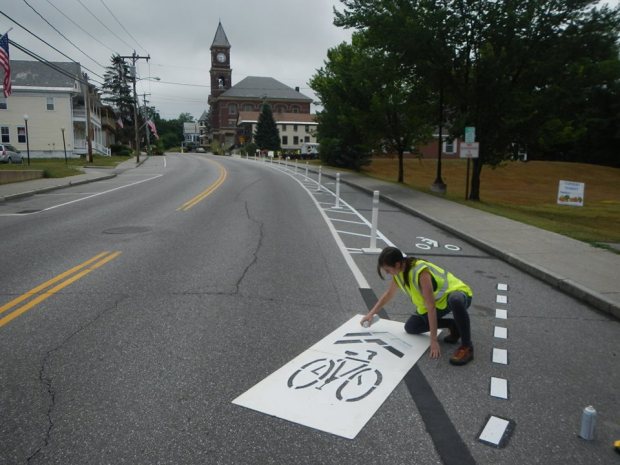
13612375_1018565084865176_4595127328645631323_nThis summer, Hinsdale participated in a Complete Streets demonstration project — a temporary installation of traffic-slowing methods — that inspired town officials and residents to move forward with the policy, said Kathryn Lynch, the town of Hinsdale’s community development coordinator.

“Drivers are not friendly toward, or stop for, pedestrians on Main Street … every day there are close calls,” noted Lynch. The town’s Main Street has four crosswalks; the street also serves as a thoroughfare for the two state highways.

“When we did the Complete Streets demonstration project this summer, we noticed that traffic really slowed down for pedestrians,” said Lynch.

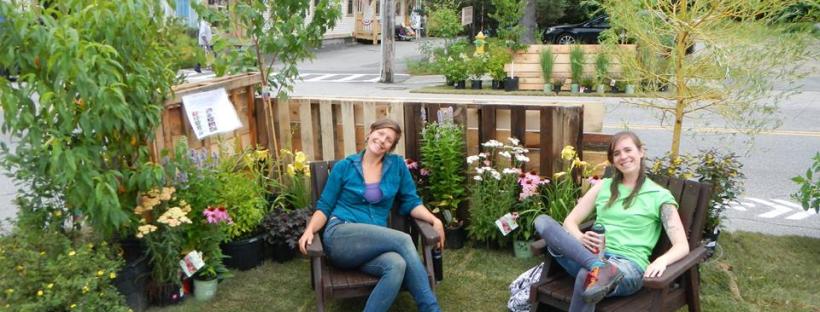
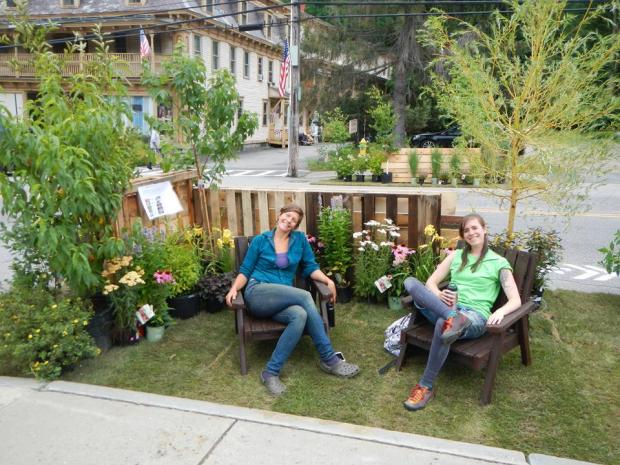
The demonstration project included a bike lane, curb bump-outs, and “parklets,” which are small parks that occupy a parking space with landscaping and benches for people to sit and relax. The parklets were placed across the street from each other, forming a ‘pinch point’ to slow traffic as it entered Main Street.
13590460_1018565864865098_4702550403317192057_n

“It really brightened up Main Street,” said Lynch. “And it worked. Traffic slowed down.”

The Hinsdale board of selectman adopted the Complete Streets policy in August. The policy requires that any construction of a new road or alteration of an existing road would take all users of the roadway, including pedestrians and bicyclists, into consideration. The policy also looks to create traffic-calming elements on its Main Street; costs would be paid for by grant money.

“We are hoping to do some parklets, or bump-outs that are seasonal,” said Lynch, who has recently applied for a grant to pay for the improvements. The bump-outs would be temporary decking material with planters and benches that could be stored during the winter months when the area needs to be cleared for snow plowing.

The town is also looking to increase the visibility of crosswalks on Main Street to alert motor-vehicle traffic to pedestrians. Lynch also hopes to convince the state’s Department of Transportation to reduce Main Street’s speed limit, currently at 30 miles per hour.

“Right now, drivers just don’t stop for us,” she said.

Other roadways in town also need improvement, noted Lynch, namely School Street where the town’s elementary middle/high schools are located. Among the problems are gaps in the sidewalk network, sidewalks that are in poor condition, and a dangerous blind curve used by schoolchildren to cross Route 119 to school. Other discussions among townspeople and selectmen have included utilizing the rail trails for pedestrian and bicycle traffic for those getting to work or school in town. Lynch is meeting with the state DOT and officials at the National Parks Assistance Program to help promote these ideas.

Complete Streets, coupled with Safe Routes to School programs in its schools, and its new 23 bike racks through the Rack it Up! program, are all steps in the right direction to make Hinsdale a more bike and pedestrian-friendly town, said Lynch.

“Complete Streets will give Hinsdale a stepping stone to make its roads safer,” said Lynch.